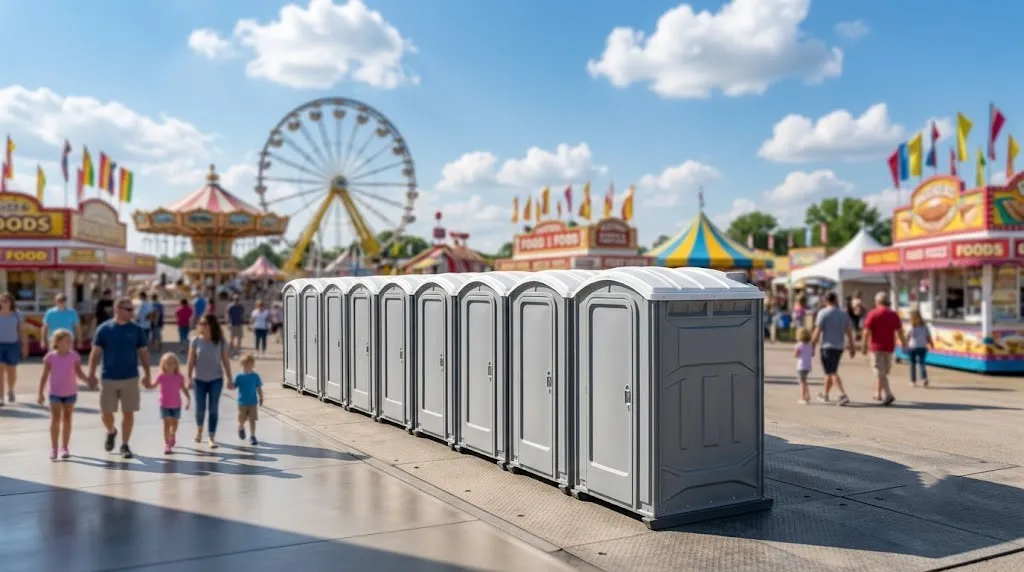
A county fair pulling a few thousand people a day needs restrooms figured by peak hourly attendance, not gate total, and most fairground layouts land somewhere between 1 unit per 75 guests and 1 per 100 once food lines and beer gardens are factored in. Newport Beach fair organizers should plan restroom orders around ANSI/PSAI Z4.3 service intervals, not just headcount.
Start with peak hour, not total attendance. A fair that draws 5,000 people over a Saturday but peaks at 1,800 mid-afternoon needs restroom counts sized for that 1,800, clustered near the grandstand, the midway and the food court separately rather than in one bank. Standard portable toilets handle the bulk of that load, and Newport Beach Porta Pros builds fair layouts around three or four smaller clusters instead of one big row, which cuts walk time and line length at once.
ADA Standards section 213.2 sets the floor: where single-user units are grouped, at least 5 percent of each cluster has to be accessible, and never fewer than one unit per cluster. That means a 20-unit bank needs at least one ADA accessible porta potty, and a fair with four separate clusters needs an accessible unit in each one, not just the biggest. Pair that with a handwashing station rental near every food vendor row, since OSHA 1926.51(a)(1) requires potable water at the worksite and fairgoers expect the same near anything they're eating.
For multi-day fairs, event restroom rental planning should also account for vendor and staff sanitation separate from public units, since crews working setup and teardown fall under different scheduling than the general public. A portable sink rental placed backstage or in the vendor corral keeps food handlers compliant without competing with public lines.
Standard units cover the midway and general grounds, but fairs with sponsor tents, VIP areas or a beer garden usually mix in something nicer. A deluxe flushable porta potty works well near hospitality tents, and fairs running a full weekend often bring in a restroom trailer rental for VIP or staff use, sized as a 2 stall restroom trailer for smaller sponsor areas or an 8 stall restroom trailer for grandstand-adjacent crowds.
| unit | day | week | event |
|---|---|---|---|
| standard | $100-$350 | $130-$500 | $200-$800 |
| ada | $200-$400 | $240-$400 | - |
| deluxe | $85-$1200 | $150-$290 | - |
| trailer | $175-$2500 | $1650-$2500 | $2499-$3899 |
Multi-day fairs typically price closer to the event or week columns depending on how many days the grounds stay open, and a porta potty rental cost breakdown can help separate delivery, service and unit fees before the invoice arrives. Fair budgets should also plan for a delivery fee, which the same cost guide covers alongside porta potty rental per day pricing if the fair only runs a single day.
Roll-off dumpsters matter just as much as restrooms at a fair. Food vendors generate volume fast, and a 10 yard dumpster rental or 20 yard dumpster rental near the vendor row keeps grease and packaging from piling up mid-event. Pair that with temporary fence rental to define restroom clusters and keep foot traffic organized, since crowd control barrier rental options also help queue lines at the busiest banks.
Fairground crowds move in waves tied to show times and food lines, so placement has to anticipate that rather than just spread units evenly. OSHA 1926.51(c) sets the baseline toilet ratio for worksites, and while a public fair isn't a construction site, the same clustering logic applies: too few units near a high-traffic zone creates lines that back into walkways. A porta potty placement guide helps organizers map clusters against the actual midway layout instead of guessing.
Ground surfaces at fairgrounds are often grass or gravel, so ADA Standards section 302.1 requiring stable, firm, slip-resistant surfaces matters for the accessible route leading to each unit, not just the unit itself. A 60 inch turning circle per ADA Standards section 304.3.1 needs to be planned into the pad space around accessible units, which takes more room than organizers usually budget for on a tight midway. Newport Beach fair sites should also confirm placement in any public right of way with the city directly, since that isn't something a rental company can clear on the organizer's behalf.
Newport Beach sits close enough to draw crews from Laguna Beach, 11.9 miles southeast, and Aliso Viejo, 13.7 miles east, which helps on multi-day fairs needing mid-event servicing or emergency swaps. For general layout questions before booking, the Construction Site Services and How Many Porta Potties Do I Need guides both cover sizing logic that applies just as well to fairgrounds as job sites.
Book as soon as dates are set, ideally 60 to 90 days out for a weekend fair. Fairground season overlaps with wedding and festival demand, so festival restroom rental inventory books up fast around the same weekends.
Yes. Food vendors need water access under OSHA 1926.51(a)(1), and 29 CFR 1910.141(d)(2) requires soap and towels or a hand-drying device at washing stations, not just sanitizer.
Yes. Multi-day fairs typically get at least one mid-event service call, and Newport Beach Porta Pros schedules extra visits around peak days like Saturday when volume spikes.
A 4 stall restroom trailer usually covers a mid-size VIP tent, while larger grandstand-adjacent VIP sections often need the 8-stall option instead.
Every cluster needs its own accessible unit under ADA Standards section 213.2. One central accessible bank doesn't satisfy the rule if the fairground has separate restroom zones.
Yes. Newport Beach Porta Pros delivers county fair restrooms across Newport Beach and the surrounding metro, with same-day and next-day drop-off available on most orders.
Pricing depends on the unit and how long you need it. See our cost breakdown and request a free quote for an exact figure.
Standard rentals include scheduled service — a pump-out, a clean, a restock and fresh deodorizer. Busy or hot-weather sites can be serviced more often.
Call now or request a free quote — clean units, on-time delivery, transparent pricing.